I escaped the Dubai heat for a week to Carinthia, the southernmost state of Austria renowned for its breathtaking beauty featuring over 1,200 lakes and snow-peaked mountain ranges.

Everything here is so vividly bright and beautiful; brilliant blue skies, emerald-green valleys, and lakes so clear and vibrantly turquoise, you can swim and drink from them. By winter, many of the mountain ranges open as ski resorts, but their beauty is surpassed even through the summer, with scenic hiking and biking trails, and a comfortably breezy yet sunny climate that doesn’t surpass the mid-twenty Celsius range.

When I got invited to Malta for a Military Heritage press trip, I really had no idea what to expect. Malta was never on my travel radar, and ‘military’ is not quite the reason I tend to choose travel destinations. My choice of travel destinations are greatly influenced by a country’s culture, gastronomic offerings, scenic trails and overall safety for women travelers. Little did I know this historically packed itinerary would encapsulate all this, and more!

Throughout my trip to Malta, we came across many churches, each breathtakingly more beautiful than the next, and it seems to me that our tour guide Mr. Zammit saved the best for last because Saint John’s Co-Cathedral literally left me speechless.

Located in the heart of the fortified city of Valletta, its outer walls are deceivingly plain, for what lies beyond the heavy ancient doors is one of Europe’s most ornate Baroque interiors. No amount of words or camera captures can summarize the immaculate beauty of this Baroque masterpiece that was built in 1572 by the Knights of St. John. It is seeped in centuries of history, painstaking artistry and a deep-rooted sense of faith that went on to become a monument to a chivalric order that shaped Mediterranean history.

In the golden light of Malta’s landscape, one ancient crop has shaped its culture, cuisine, and survival for thousands of years: olive oil. During my Military Heritage Press Trip to Malta, we had the absolute pleasure of being hosted for dinner one evening under the Maltese night skies and olive groves at Ta’Xmun Olive Grove. With us was Professor Noel Buttigieg, Head of The Department of Tourism Management at the University of Malta. He gave us an insightful lecture on the significance of olive oil in Maltese history, and I had to summarize his teachings the best I could right here on The Tezzy Files.

Infront of the iconic Red Tower, also known as St. Agatha’s Tower, showcasing its distinct rust-red exterior and 17th-century architecture.

Perched high above Mellieħa Bay, The Red Tower (also known as St. Agatha’s Tower), is one of Malta’s most iconic 17th-century watchtowers. Apart from large fortifications, Malta’s network of coastal watch towers began taking form in the early 17th century, primarily under the rule of the Order of St. John. These towers were constructed as a direct response to increasing threats from Ottoman forces and Barbary pirates, who frequently raided the Mediterranean.

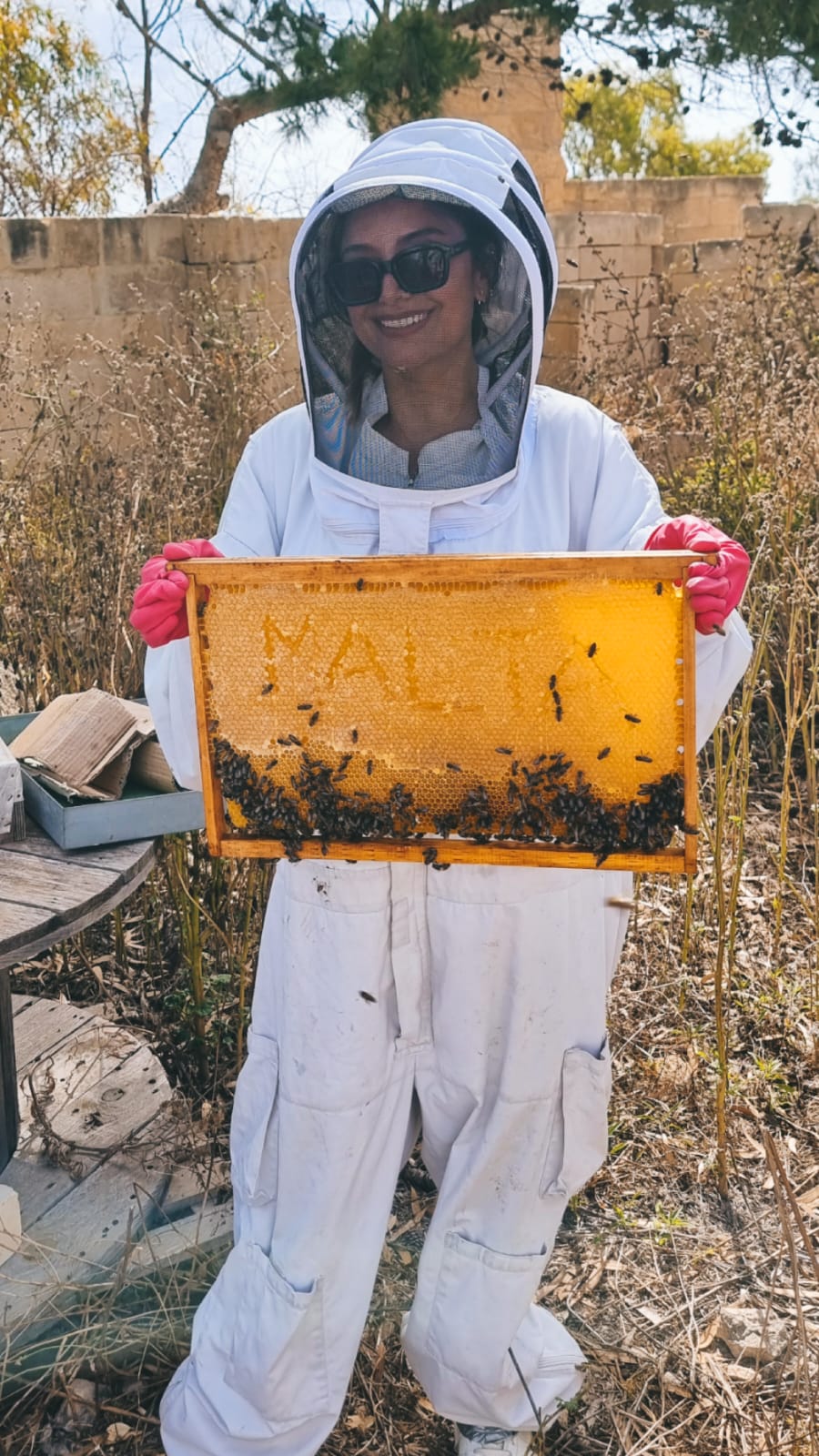
Malta’s association with honey is so ancient that its very name is derived from the Roman word “Melita” meaning ‘honey-sweet’. Historians debate on whether the country got its name for its highly sought after honey, or its honey-hued stone architecture. Whichever it may be, there is no doubt that Maltese honey was considered in high regard since Roman times, and the island’s long-standing connection to apiculture (beekeeping) only grew in sophistication under Roman rule since 218 BC.

The Romans believed honey was so much more than a sweetener. They valued honey for its medicinal properties, and even used it as a valued item of trade.